
Tools and hands
The object and process determine the tool: repeatable gripping, adaptive enveloping or coordinated finger motion. Each arm has a tool profile with mechanics, power, driver and feedback.
Choose the contact
Control and contact
Commands, contact and feedback define the tooling concept. For hands, DoA counts independent actuators; DoF describes motion freedoms. Coupling and underactuation distribute inputs across the fingers. Teleoperation maps human-hand motion to the actual device axes.
Tool example SCHUNK EGK 25
- Command
- Opening width / grip
- Contact
- Defined finger surfaces
- Feedback
- Position / grip status
The selected tool profile defines jaw stroke, force limits and part detection.
7 / 7 hands · grouped by control concept

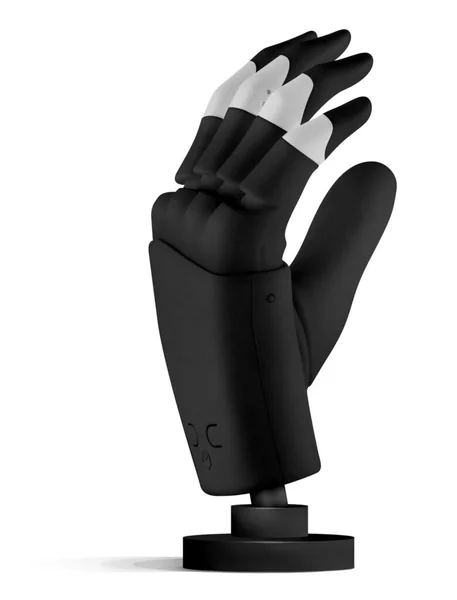
Mia Hand
3 actuators · 4 DoF
Details & sources
- Application
- Adaptive grasping of everyday objects and tools with a compact command space.
- Control concept
- Middle, ring and little fingers are coupled. Industrial: seven preset grasps with position/speed control.
- Interfaces
- Industrial: RS-485, 24 V. R&D: UART over USB with manufacturer ROS 1/ROS 2 packages.
- Feedback & integration
- Position, motor current and limit switches; optional force sensors. Force control is announced.

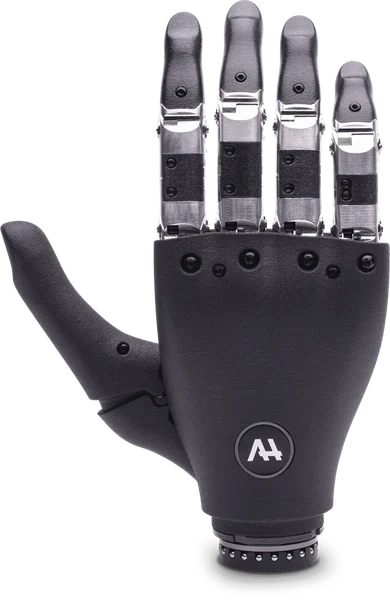
Adam’s Hand / Plus
Plus: 3 motors · 10 driven DoF
Details & sources
- Application
- Enveloping grasps that adapt mechanically to the object; useful when individual finger trajectories are not the task.
- Control concept
- Plus: one motor with differentials drives four fingers; two motors control thumb flexion and rotation. The ten driven DoF are mechanically coupled; the classic prosthetic model uses two motors.
- Interfaces
- Bluetooth, Wi-Fi and SDK. RS-485, CAN, Ethernet and native ROS 2 are announced.
- Feedback & integration
- Manufacturer lists current, position, speed, IMU and motor torque. Force/temperature sensing and slip detection are announced.

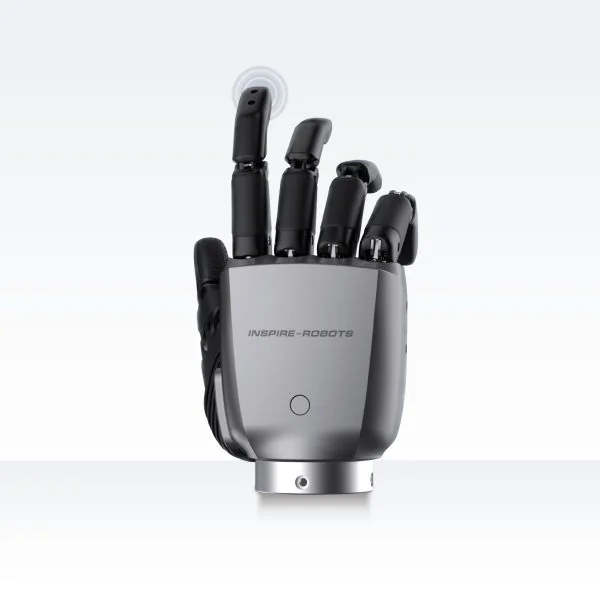
RH56F1
6 DoF · 12 joints
Details & sources
- Application
- Anthropomorphic grasping with a small control vector; a concrete EtherCAT option for peripheral integration.
- Control concept
- Six controlled DoF coordinate twelve joints. Grasp and teleoperation targets map to six device axes.
- Interfaces
- E2: EtherCAT + RS-485; E4: EtherCAT + CAN FD. Supply: 24–48 V; left/right hand and sensing follow the variant.
- Feedback & integration
- T1 variants add eight tactile sensors according to the manufacturer’s variant table.
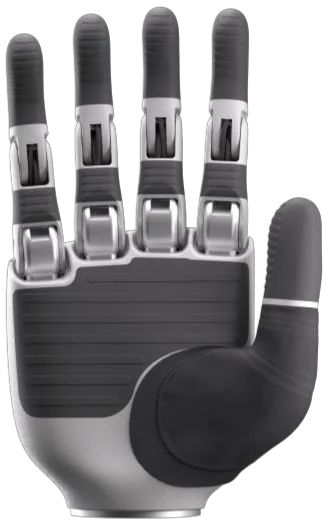
Surge
6 powered DoF · modular fingers
Details & sources
- Application
- Grasping and glove-based teleoperation with individually replaceable finger modules.
- Control concept
- Six powered DoF with MANUS glove compatibility. Retargeting maps glove motion to the hand’s axes and limits.
- Interfaces
- RS-485; 48 V nominal (datasheet v1.3). Protocol and firmware are selected for the hand variant.
- Feedback & integration
- Optional tactile force sensing: 80 individually addressable taxels per finger. Taxels are sensing elements, independent of motion DoF.

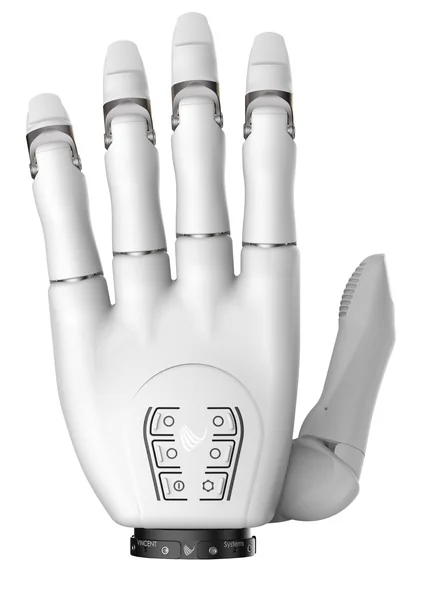
VINCENTevolution5
6 motors · 6 independent DoF · 11 joints
Details & sources
- Application
- Human-shaped handling for service and humanoid robotics; demonstrated by the manufacturer on KIT’s ARMAR-7.
- Control concept
- Six motors control six independent DoF across eleven joints. Interface and software are adapted for robotics.
- Interfaces
- Robotics interface, power supply and SDK are specified for the selected robotics variant.
- Feedback & integration
- Telemetry fields and update rates are specified with the selected robotics interface.

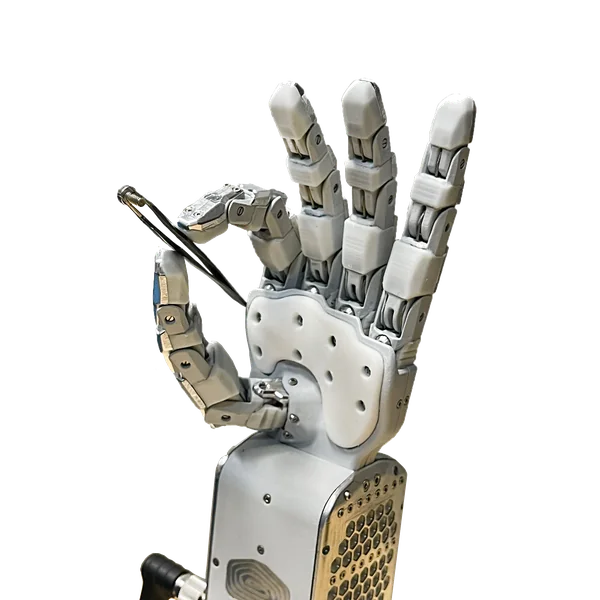
ARTUS Lite
20 DoF · 16 actuated + 4 underactuated
Details & sources
- Application
- Fine manipulation, finger coordination and learning tasks that require many independent joint targets.
- Control concept
- Lite API: sixteen joint targets and four underactuated DoF. The hand model defines joint order, limits and retargeting.
- Interfaces
- ARTUS family Python API: RS-485/Modbus RTU or TCP. Transport and API version follow the model’s compatibility profile.
- Feedback & integration
- State reads, calibration and fault handling follow the selected hand, firmware and API profile.

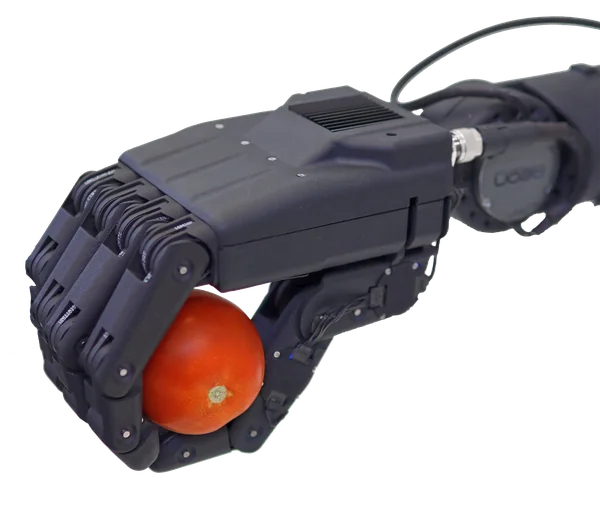
HandEffector
11 / 14 QDD actuators · 11–19 DoF
Details & sources
- Application
- Contact-sensitive grasping with joint torque information and perception close to the object.
- Control concept
- Quasi-direct-drive actuators with joint torque sensing. Actuator count, passive joints and finger abduction follow the configuration.
- Interfaces
- RS-485 and USB, 24 V. Command modes and update rates are specified for the selected configuration.
- Feedback & integration
- Joint position, velocity and torque; integrated 5 MP RGB camera, ToF depth sensor and ARM processor with AI accelerator.
One profile per tool
| Layer | Profile content |
|---|---|
| Mechanics & power | Left/right variant, adapter, tool frame, mass/centre of gravity, voltage and peak current |
| Driver | Bus and firmware; grasp presets, finger-group or joint targets; supported command modes and limits |
| Feedback | Position/current, joint torque, fingertip force or tactile arrays; timestamps and calibration |
| Behaviour | Grasp confirmation, communication timeout, release/hold, reset and recovery |
Contact at the wrist
A six-axis wrist sensor measures the resultant force and moment. Tactile elements measure local finger or palm contacts. Select one or both wrists for the process and update the tool profile when changing tools.
Continue with force/torque sensing, Control and interfaces and the hardware ecosystem.