
Vision-language-action models
Start VLA research with a prepared robot embodiment and development environment. PLEXA connects the robot platform, cameras and compute with examples that help you explore how observations become actions.
VLA in three terms:
- Vision: camera images and observations of the scene.
- Language: the task expressed as an instruction.
- Action: predicted robot actions matched to the particular embodiment.
Model-specific guides are coming soon. The project links open the upstream sources.
GR00T · OpenVLA-OFT · openpi · SmolVLA · X-VLA
See the learning workflow
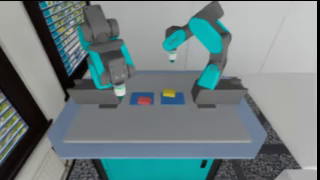
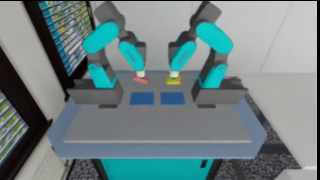
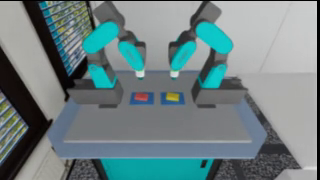
X-VLA example: the prepared Dual-HORST embodiment provides the basis for this runnable simulation case. The sequence shows one learned task through an external camera. New tasks and transfer to a physical robot require adaptation and evaluation.
Capture details and model checkpoint
Selected research example: three original frames of a Dual-HORST/X-VLA simulation, case w1-dev-002, model Saved6000, viewed through an external camera. This example illustrates one learned task in simulation, not a ready-to-use physical robot skill.
Build your own capability
The prepared kit software gives students, researchers and developers a starting point for local models, data work and experimentation. Model families such as GR00T, OpenVLA-OFT, openpi, SmolVLA and X-VLA use different observation and action formats; choose one for your task.
Collect demonstrations, check the data, adapt or fine-tune the model, and evaluate on separate cases. Your own objects, camera views and robot configuration require your own training and integration work. A prepared environment does not mean a universally trained policy.
Coming soon
Model-specific guides and the detailed path from demonstrations to evaluation will follow. Start with the prepared tools and a clearly scoped research question.